
📞 (828) 539-4201
Licensed & Insured Since 2019
Permits Handled End to End

Fiberglass Pools in Asheville, NC

Pool Builders of Asheville installs fiberglass pools across Buncombe, Henderson and Madison counties. A fiberglass pool is a one piece shell made in a factory mold and delivered to your property complete, with the steps, the bench seats, the tanning ledge and the depth profile already built into it. There is a large range of shapes and sizes to choose from, and we will help you work out which of them your property will take.

Because the shell is finished before it arrives, the work on your property is ground work: the dig, the base the pool will sit on, the drainage, any retaining walls, and the patio that goes around it. On mountain ground that is the part of a pool project that decides both the schedule and the price, and it is the part we take off your hands.

What a fiberglass pool installation involves

The site visit

Before anything is priced, we come out and measure your yard. We check how much your land slopes where the pool would go, how deep the rock is, where water runs in a heavy rain, how wide and how steep the driveway is, and how far it is to your electrical panel. We also work out whether a truck carrying a shell up to 40 feet long can get in, and whether a crane can park somewhere within reach. Those measurements decide the design and most of the price, which is why we will not put a figure on the project before we have taken them.

Choosing the shell

Choosing the shell happens earlier in a fiberglass project than most people expect, because every fiberglass pool comes out of an existing mold. The shape, the steps, the bench seats, the tanning ledge, the depth profile and the interior color are all settled at the same moment. None of it can be changed once the shell has been made. We will go through the models with you properly, because this is the decision the rest of the project is built around.

Permits

The application goes to the county along with the pool drawings and the manufacturer’s setting details. We handle the permitting from application through final inspection, so you do not file anything and you do not chase an inspector.

The dig and the base

The hole is dug wider than the shell so that there is room to work around it and room to fill it back in properly afterward. A fiberglass shell is thin and rigid, and it holds its shape because of what sits underneath and around it. If the ground under the pool is soft, or if the material at the sides washes out, the shell will move. Almost every fiberglass horror story you will read online begins there.

The base under the shell is what prevents all of it. It has to drain, and it has to support the whole floor of the shell rather than a few high points.

Setting the shell

A crane lifts the shell off the truck and sets it into the hole. On a straightforward property that happens the same afternoon the truck arrives. It is also the moment the whole project has been planned around, because the crane has to get close enough to reach, which is why we check your access at the beginning.

Plumbing, filling and electrical work

Water goes into the pool and material goes in around the outside of it at the same time, in layers, so that the pressure stays even on both sides of the wall. The plumbing runs to an equipment pad carrying the pump, the filter and the heating if you are having it. The electrical work is done by a licensed electrician and inspected.

Edging, patio and drainage

The edge of the shell is capped and the patio around it is laid. Water gets dealt with at the same time, which means deciding where roof water and hillside runoff go, and where they go instead of across the pool area. On sloped ground this is not a finishing detail. It decides whether the surround is still level in five years.

Filling and handover

We fill the pool, balance the water, and start up and set the equipment. Then we show you how to run it, including the pump schedule, the filter, the heater and what to do at the end of the season.

Fiberglass pool sizes, shapes and depths

Widths and lengths

Widths run from around 8 feet up to 16 feet, and lengths reach roughly 40 feet. The upper limit comes from the road rather than from the pool. Most states cap an oversized load at 16 feet wide, and a fiberglass shell has to travel to you on a truck, so 16 feet is where the range stops.

The middle of the range, roughly 13 to 16 feet wide by 28 to 37 feet long, is where most family pools sit and it suits a good number of yards in this region.

At the narrow end there are models around 8 feet wide, although the choice of them is limited. If your property needs a pool that narrow, we would also show you a precast concrete pool, which starts at around 7 feet and gives you more options at that size.

Depths

Depth belongs to the model you choose and cannot be specified separately, so the shell decides whether you get just under 5 feet or closer to 8. Flat bottom shells generally hold a little under 5 feet of water the whole way across, which is deep enough to swim in and shallow enough to stand up anywhere. Deeper models step down toward one end, and the deepest of them reach around 8 feet.

If you want a diving depth, say so at the very start of the conversation, because it reduces the list of available models considerably.

What is molded into the shell

The shape, the steps, the bench seats, the tanning ledge, the swim out, the depth profile and the interior color are all part of the shell. Between them the manufacturers offer a large range. That covers rectangles, freeform outlines and lap pools. It also covers a tanning ledge across one end, a spa seat built into a corner, or a wide entry step running the width of the shallow end.

Most people find something in that range which is close to what they had in mind. We will go through the options with you and narrow them down to the ones your property will physically take, which is usually the shorter list.

What a fiberglass pool cannot do

Because every fiberglass shell comes from an existing mold, you cannot draw your own shape, you cannot change the depth, and you cannot move a step or a bench. Nothing built into the shell can be added or altered after it is made.

You are trading one thing for another here. You give up designing the pool yourself, and in return you get a pool that arrives complete instead of being built in your yard over several months. If the shape will not compromise, you want a gunite pool, and we would rather work that out with you at the start than sell you a shell you settled for.
Not sure which pool suits your property?

Tell us where you are and what you are picturing, and we will work through the options with you.

Request a Quote

What we can add to a fiberglass pool

Heating

At this elevation the water temperature, not the air, decides how long your season lasts, so a heat pump and a cover belong on the first quote. The middle of summer is warm enough on its own. A heat pump and a cover are what give you May and September, because clear mountain nights draw heat out of a pool overnight and an unheated pool gives back most of what the day put into it.

Covers

A cover does two jobs at once, because it holds heat in overnight and it keeps leaves out, which matters a great deal when your yard has hardwoods around it. An automatic cover runs on a track and closes in under a minute. A mesh safety cover is a seasonal one that goes on for winter.

Lighting

LED lights sit in the shell wall and are wired at the same time as everything else. Lighting around the pool, on the steps, along the edges and through the planting, runs off the same circuit and is far cheaper installed now than added later.

Salt chlorination and automation

A salt system makes chlorine from salt dissolved in the water, so you are not carrying jugs of chemical. The water does not taste salty, because the concentration is roughly a tenth of seawater. Automation puts the pump, the heating, the lights and the sanitizer on a schedule you can change from your phone.

Water features and swim jets

Spillways, sheer descents and swim jets can be added, although you should check whether the model supports them before settling on it, because some fittings have to be built into the shell when it is made.

The space around the pool

The patio and decking, the edging, an outdoor kitchen, a fire pit, a shaded area and the planting all belong in one scope with the pool. Doing them together costs less and it is the only way the levels and the drainage come out right.

Fiberglass pools on Western North Carolina properties

The strongest argument for fiberglass on a mountain lot is how few weeks your yard spends as a construction site. A pool built in place means weeks of open ground, machinery and trades in your yard. A shell that arrives finished compresses all of that into the ground work, which on a mountain lot is where the difficulty sits anyway.

The smooth surface earns its place in this region as well. Water up here carries whatever the hillside gives it, and gelcoat holds less than plaster does, so the pool takes less sanitizer and less brushing to keep clear.

Access is the most common obstacle

Access is the single most common reason a fiberglass pool does not happen on a property around here. The shell arrives whole on a truck and is lifted by a crane, so it needs a route in and somewhere for the crane to stand within reach. Narrow driveways, sharp switchbacks, mature hardwoods and overhead power lines are ordinary on properties in this region, and any one of them can rule out a full size shell.

None of those obstacles rules out a pool altogether. A narrow fiberglass model sometimes gets in, and a precast concrete pool from around 7 feet wide often does. A gunite pool is built in your yard and needs no delivery at all. We look at your driveway before we look at anything else, so that you learn early what will fit.

Septic systems decide where the pool can sit

A great deal of this market is on septic, and where the septic system sits decides where the pool can go.

Nothing can be built over the tank or the drain field. Not the pool, not the patio, not the equipment pad. The field also has a reserve area that has to stay clear so that it can be replaced one day, and that reserve gets built over by accident more often than anything else, because there is nothing to see on the surface.

Locating the tank, the field, the reserve and the buried lines is one of the first things we do on a site visit. It is also a common reason a smaller shell turns out to be the right answer, because a compact pool fits into a space a large one will not.

Rock

Rock is normal here and it appears as a cost rather than as a reason to stop. The question worth asking is whether it was priced before the dig began or discovered halfway through it, and we would encourage you to put that to every quote you are comparing.

Fiberglass, precast concrete or gunite?

Fiberglass and precast concrete

Both arrive as a finished shell and both are craned into place, so the work on your property is similar, and the differences come down to material and range. A precast pool is reinforced concrete cast and cured in a factory, in sizes from around 7 feet by 7 up to roughly 12 by 26, holding a little under 5 feet of water throughout. A fiberglass pool is a composite shell with a much wider choice of shapes and depth profiles, including tanning ledges and swim outs molded in, but with fewer options at the narrow end.

Fiberglass and gunite

A gunite pool is sprayed in place over a steel cage in your yard, so it can be any shape and any depth. It also has to cure where it is built, which takes about a month, with the tile, the interior finish, the filling and the startup all following that. A fiberglass shell ordered on the same date is already swimming. Gunite is the right choice when the design needs a shape or a depth that nothing is molded in, or when nothing can be delivered to the property at all.

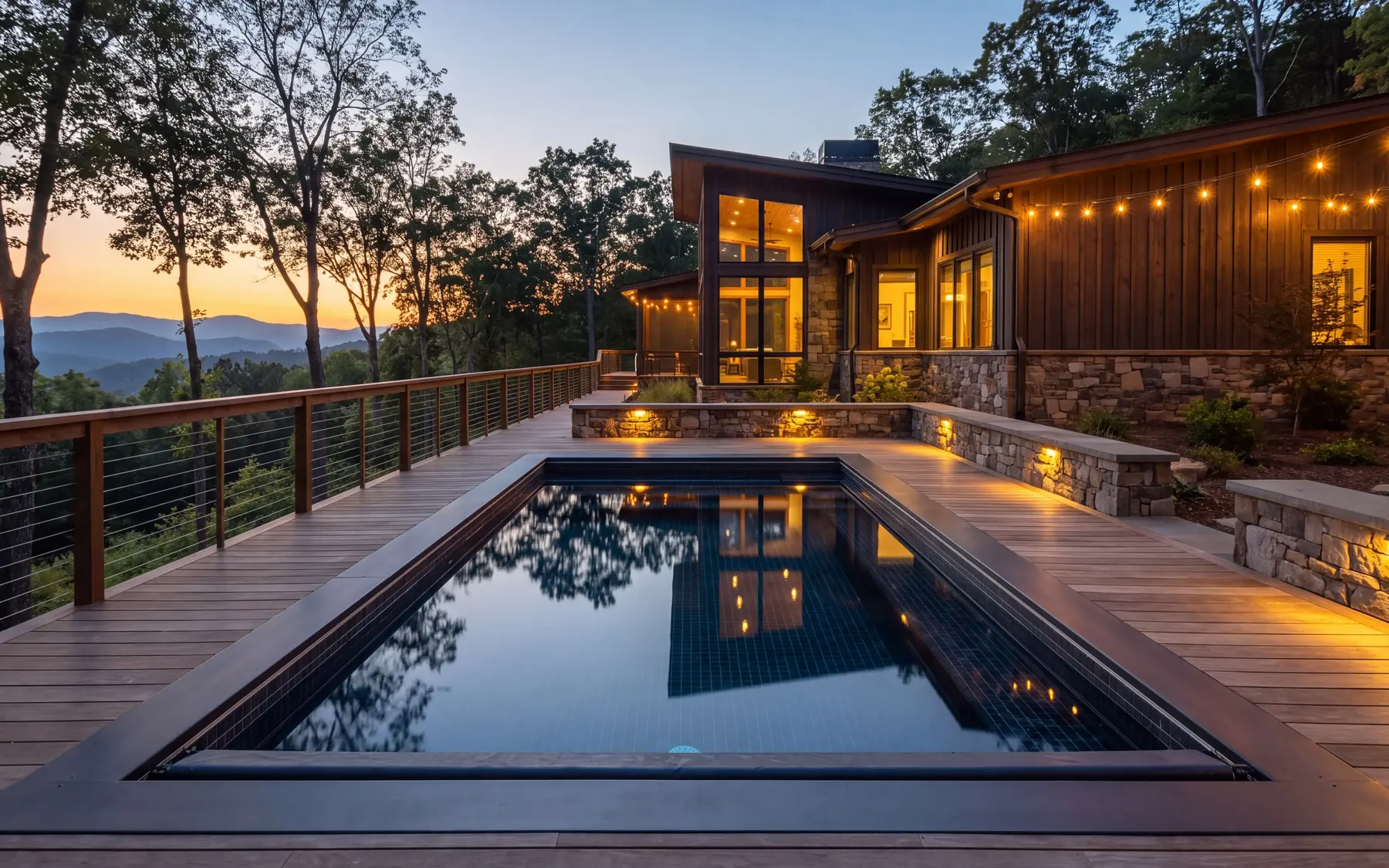
Pool set into a timber deck with landscape lighting at dusk
One company, one quote

The grading, the pool, the decking, the lighting and the planting run as one project on one schedule, rather than five separate trades for you to coordinate.

We handle the permitting from application through final inspection, so you do not file anything and you do not chase an inspector.

See all services

How much does a fiberglass pool cost in Asheville?

Most fiberglass pools in this area land between $60,000 and $150,000 installed.

The lowest figure in that range assumes a level site: flat ground, easy access for the truck and the crane, and a modest surround, all of which is the exception around here rather than the rule. How much grading and excavating your ground needs is the single biggest thing moving your number, along with the size of the shell and everything you put around it, including decking, patio, a shaded area, tile, rockwork and water features.

What moves you inside the range

The ground work. Cutting into a slope, building walls to hold back what sits above the pool, and hauling away what comes out of the hole. Ground work is the largest single variable in a quote in this region.

Rock. Whether there is any, how deep it begins, and how it has to be broken out.

Access. Whether the truck and the crane can reach the backyard, or whether the shell has to be handled a longer and more difficult way.

The model you choose. The size of the shell and everything built into it.

The surround. Square footage times material. Concrete, pavers, stone and tile cover a wide spread, and on most projects the patio costs more than people expect.

Heating, a cover, lighting and automation. Each one is a real line on the quote, and each one is cheaper installed with the pool than added afterward.

Drainage and retaining walls. On sloped ground this is often the entire difference between two quotes that otherwise look identical.

What drives the cost of a pool in this region

How long does a fiberglass pool take?

Most fiberglass projects are completed in 4 to 12 weeks, from the first day on site to the day you swim. The shell itself is set into the ground in a single day, because it is built before it reaches you.

Permitting comes first and has to be in hand before the ground is broken. Then comes the dig and the base, the setting day, the plumbing and electrical work, filling in around the shell, and finally the edging, the patio and the drainage. On a property that needs a great deal of ground moved, or that turns up rock, it takes longer, and it is the ground that decides that, not the pool.

Weather is a real part of the schedule here, because ground work during a wet spell does not slow down, it stops.

Is a fiberglass pool right for your property?

A fiberglass pool suits you if

  • You want the pool finished and swimming this season rather than watching it be built
  • One of the molded shapes is close to what you had in mind
  • A truck and a crane can reach your backyard
  • You want a smooth surface that is easy underfoot and takes less upkeep
  • You would rather your yard spent weeks as a building site than months

A fiberglass pool is the wrong choice if

  • The design needs a shape or a depth that nothing is molded in. That is a gunite pool, and compromising on the mold will not fix it.
  • Nothing wide can reach the backyard. A precast concrete pool from around 7 feet, or a gunite pool built in place, is the better answer.
  • Your yard is small and awkward. There are only a limited number of narrow fiberglass models, and a compact precast shell usually gives you more to choose from.
  • You want a pool you can swim proper laps in. Sixteen feet wide and forty feet long is the ceiling. Beyond that it is gunite.
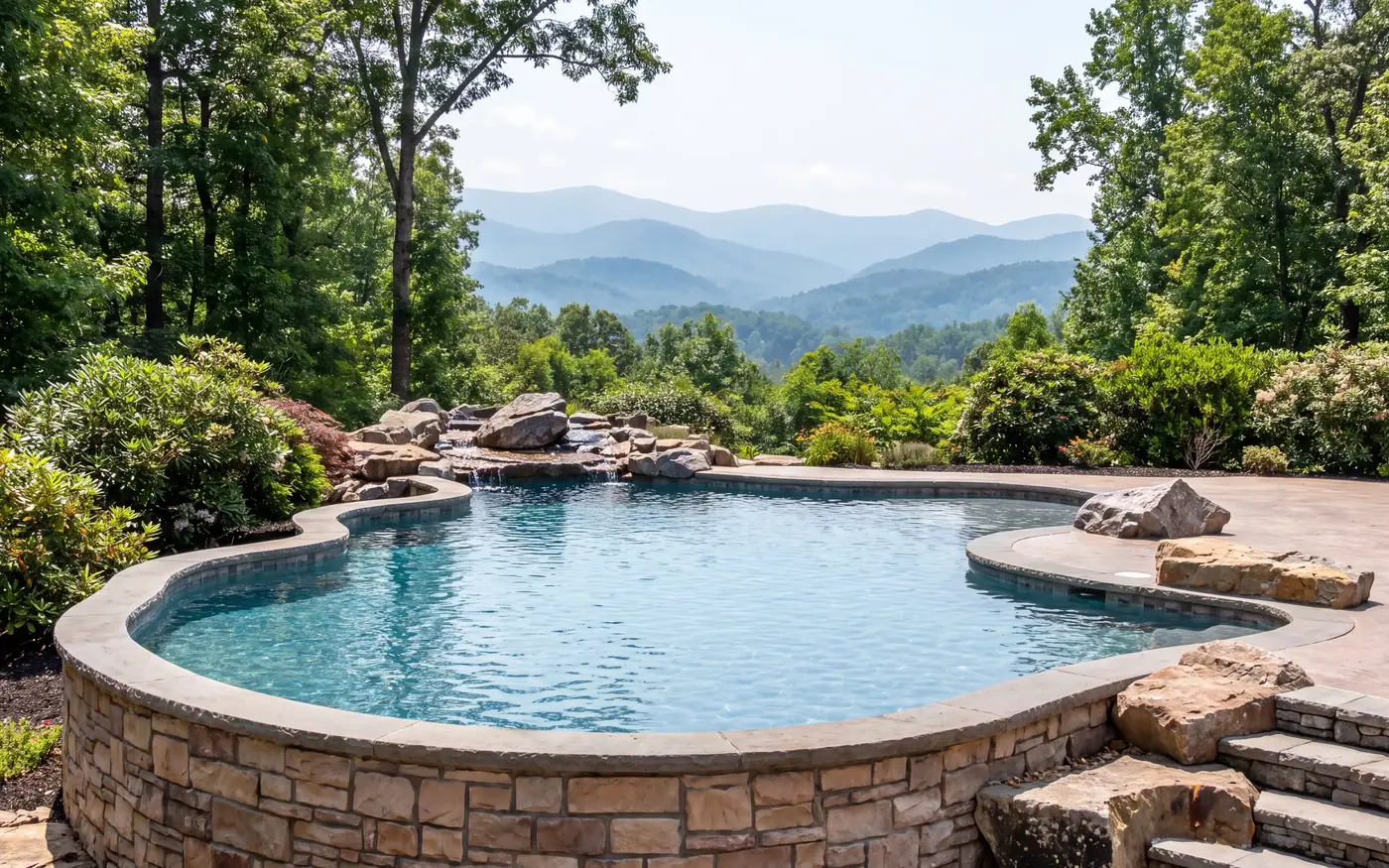
Freeform pool with a boulder waterfall and a mountain view
Built for mountain property

Three things decide a pool project in this region: the slope of your land, the ground underneath it, and how easily we can reach the backyard. Our recommendation follows your property rather than a catalog, which on mountain ground matters a great deal more than it does anywhere flat.

Talk to us about your backyard

Talk to us about a fiberglass pool

Tell us where you are and what you are picturing. We will come out, measure what you have, and work through with you which pools suit your property and what each one would cost. If fiberglass is the right answer we will go through the models that fit. If it is not, we will say so and show you what does.

Fiberglass Pools in Asheville, NC FAQs

What sizes do fiberglass pools come in?

Widths run from around 8 feet up to 16 feet, and lengths reach roughly 40 feet. The 16 foot ceiling comes from the road rather than from the pool, because most states cap an oversized load at 16 feet wide and the shell has to travel to you on a truck. There are only a limited number of models made at the narrow end, so if you need something under 10 feet wide we would also show you a precast concrete pool, which starts at around 7 feet and offers more choice at that size.

How deep can a fiberglass pool be?

It depends on the model, because depth is built into the shell rather than chosen separately. Flat bottom models generally hold a little under 5 feet of water throughout, which is deep enough to swim in and shallow enough to stand up anywhere. Deeper models step down toward one end, and the deepest reach around 8 feet. If you want a diving depth, tell us at the start, because it narrows the list of models considerably.

Can a fiberglass pool be made in a custom shape?

No. Every fiberglass pool comes out of an existing mold, so you are choosing from a range of shapes rather than drawing your own. The range is large and most people find something in it that suits them. If the pool you want is a shape nobody makes, that is a gunite pool, which is built in your yard and can be any shape at all.

How long does a fiberglass pool take to install?

Most fiberglass projects are completed in 4 to 12 weeks. The shell itself is set into the ground in a single day, and the rest of that time covers the dig, the base the pool sits on, the plumbing and electrical work, filling in around the shell, and then the patio and the drainage. How much your ground has to be reshaped decides most of the schedule.

How much does a fiberglass pool cost around Asheville?

Most projects land between $60,000 and $150,000 installed. Your property decides where inside that range you sit: how much the ground has to be cut and held back, whether there is rock, whether a truck and a crane can reach the backyard, and how much patio and decking you are laying.

Do fiberglass pools crack or lift out of the ground?

Both of those are ground problems rather than shell problems. A shell moves when what is underneath it moves, which means a base that was not compacted properly, or material around the sides that washes out. Water pressure in the ground is what lifts a pool, which is why the drainage around and under it matters more here than it does on flat, dry land. That is what the site work is for, and it is the part of the quote we will walk you through in detail.

What is the surface like compared with a concrete pool?

It is smooth. The inside face is gelcoat, the same finish used on a boat hull, so there is nothing rough underfoot on the steps or the floor. A concrete pool is finished in plaster, quartz or pebble, all of which have more texture. The smooth surface also holds less algae, so a fiberglass pool takes less sanitizer and less brushing to keep the water clear.

Can you add a spa or a tanning ledge?

Only if the model you choose has one. The steps, the bench seats, the ledges and the spa seats are part of the mold, so they are chosen when you choose the shell and cannot be added afterward. A separate spa can be built alongside the pool and plumbed to run from the same equipment, which is a structure sitting next to the pool rather than part of it.

I am on a septic system. Can I still put in a fiberglass pool?

In most cases yes, although the septic system decides where the pool can sit rather than you. Nothing can be built over the tank or the drain field, including the patio and the equipment, and the field also has a reserve area that has to stay clear. Locating all of it is one of the first things we do on a site visit, and it is a common reason a smaller shell turns out to be the right answer.

Will a fiberglass pool work on a sloped lot?

In most cases yes. The pool can be dug into the hillside with the ground above it held back by a retaining wall, or it can sit higher with the ground built up underneath it, which gives you a more level yard at the same time. The question to answer before slope is access, because a shell up to 16 feet wide needs a route in, and around here that rules out more projects than the slope does.

What if a truck cannot reach my backyard?

We check that before we design anything rather than discovering it later. Narrow driveways, sharp turns, low branches and overhead power lines are all normal in this region. Where a full size shell cannot get in, a narrow fiberglass model sometimes can, a precast concrete pool from around 7 feet wide often can, and a gunite pool is built in your yard so there is nothing to deliver at all.

Do I need a permit for a pool in Buncombe County?

Yes, and the barrier around the pool and the electrical work form part of it. We handle the permitting from application through final inspection, so you do not file anything and you do not chase an inspector.

Do you build the patio and decking as well?

Yes, and we would encourage you to have it done at the same time. The edging and the patio and decking, in concrete, pavers or stone, go into the same quote along with the drainage, the lighting and the planting around the pool.

Get a Quote for Your Pool

Tell us where you are and what you are picturing. We will come out, measure what you have, and work through with you which pools suit your property and what each one would cost.

Call Now Free Quote