
📞 (828) 539-4201
Licensed & Insured Since 2019
Permits Handled End to End

Inground Pool Installation in Asheville, NC

Pool Builders of Asheville installs inground pools across Buncombe, Henderson and Madison counties: precast concrete pools, fiberglass pools and gunite pools. Most of our precast and fiberglass projects are completed in 4 to 12 weeks, because the pool is built before it reaches your property. We design every pool around what your land will take.

Most of our precast concrete and fiberglass pools are completed in 4 to 12 weeks. An inground pool in this region is a general contracting job that happens to end in water. The grading, the drainage, the retaining walls, the concrete, the plumbing, the electrical work and the patio all have to be sequenced and inspected in the right order. On a sloped property most of the difficulty is finished before the pool itself arrives, and all of it is work we take off your hands.

Which pool is right for your Asheville property?

If your lot is steep

Yes, you can put a pool on a steep lot, and most of the lots we work on are not flat. We design inground pools to fit the mountain topography of your property. Depending on how your land sits, we can dig the pool into the hillside, or we can build retaining walls that hold the ground back. Retaining lets us position the pool exactly where you want it, and it gives you a more level yard to use at the same time.

At the site visit we will go through how much of the project is ground work, because on a steep property that is usually the largest part of the quote after the pool itself. We will work with you to figure out exactly which pool type is most suitable for your backyard.

If access is tight

Narrow driveways, sharp turns, low branches and overhead power lines are normal around here. Any one of them can stop a pool shell that is 16 feet wide from ever reaching your backyard.

None of that stops us putting a pool in. Precast concrete pools start at around 7 feet wide and fiberglass pools at around 8, so we can bring a finished shell down a driveway that a full size pool would never fit. There is more choice at that narrow end in precast than there is in fiberglass, where only a limited number of models are made that small. Gunite pools are built in your yard instead of being delivered, so there is nothing to bring in at all.

We look at your access before we design anything, so you find out early what fits rather than after you have settled on a pool. We will work with you to find one that suits your backyard and the way into it.

If your yard is small

An inground plunge pool could be the perfect pool for a small yard. Precast plunge sizes start at around 7 feet by 7, and although fiberglass pools begin at around 8 feet wide the choice of models that narrow is limited. Either way, a compact precast concrete pool or a smaller fiberglass pool still functions as a pool while being so much easier to maintain, heat and cool.

The reason a smaller pool is easier to live with comes down to how much water you are heating and treating. A plunge pool warms up far more quickly than a full size pool, it costs noticeably less to heat through spring and fall, and it needs a fraction of the chemical to keep the water clear. In the mountains, where a heater gives you a season worth having, that difference shows up every month you are using the pool.

Both leave room for a patio, which is what actually makes a small yard usable. When we design a small backyard we lay the whole space out with you at the same time, so that the pool, the seating, a shaded spot and somewhere to put a table all have room. Fitting the pool in first and squeezing everything else around it afterward is how small yards go wrong.

If you want to swim rather than cool off, we can build swim jets into a precast shell so that you swim against a current in a pool a fraction of the length. We will walk you through that decision before the shell is made, because anything built into a precast pool cannot be added later.

Building a large pool on a small lot can limit the functionality of the backyard. We will come out, measure what you have and work through the sizes with you, so that you can see what the pool leaves you before you commit to anything.

If you want a custom shape

A gunite pool is the one type that has no limit on shape, because the outline is drawn rather than chosen from a range. We can build a freeform pool that follows the line of your hillside, or a beach entry that walks in from the patio with no step at all. We can build a spa into the pool structure so that it spills into the water, or run a vanishing edge along a property where the ground falls away behind the pool.

Gunite costs the most of the three and it takes the longest, because it is built in your yard rather than delivered. If the shape matters that much to you, it is worth both.

Before you commit to that expense, look at what the other two can do. Precast concrete pools come in sizes from around 7 feet by 7 up to roughly 12 by 26, with tile finishes, spa jets, waterfalls and lighting all built in at the factory. Fiberglass pools come in a very large range of shapes and sizes. Widths run from around 8 feet up to 16 and depths reach around 8 feet, with steps, bench seats, tanning ledges and swim outs molded into the shell. Many people arrive expecting to need a custom pool and find that one of the two delivered options is already what they had in mind, for less money and in a fraction of the time. We will show you both before you decide.

If your pool is for a vacation rental

Short term rental property in this area gains more from a pool than from almost any other improvement, and the priority is usually getting it finished and earning rather than getting it perfect. That points toward a precast concrete or fiberglass pool, because the shell arrives complete and the project is measured in weeks rather than months.

A rental pool is also used harder than a family pool, which makes the interior finish, the cover and the barrier worth thinking about properly. We would recommend confirming what your county and your insurer require of a pool that guests use before the design is settled, and we are happy to work through that with you.

If you want your pool finished quickly

Precast concrete and fiberglass pools are both set into the ground in a single day, because the shell is manufactured before it ever reaches your property. Most of these projects are completed in 4 to 12 weeks, from the first day on site to the day you swim. Everything else in that schedule belongs to the work on your lot: the dig, the base the pool sits on, the plumbing and electrical, filling in around the shell, and then the patio and the drainage.

A gunite pool is measured in months rather than weeks, and the 28 day cure on the concrete is the part of that which cannot be shortened.

If you are on a septic system

A great deal of this market is on septic, and the septic system decides where the pool can sit and sometimes how large it can be. Nothing can be built over the tank or the drain field, including the patio and the equipment pad, and the field also has a reserve area that has to stay clear so that it can be replaced one day. The reserve gets built over by accident more often than anything else, because there is nothing to see on the surface.

Locating the tank, the field, the reserve and the buried lines is one of the first things we do on a site visit, and a narrow pool has options that a wide one does not. Working around a septic field is one of the most common reasons a precast concrete pool of 7 or 8 feet wide turns out to be the right answer. A small fiberglass pool sometimes works on the same properties, where a full size shell simply would not fit.
Not sure which pool suits your property?

Tell us where you are and what you are picturing, and we will work through the options with you.

Request a Quote

The three types of inground pool we install

Precast concrete pools

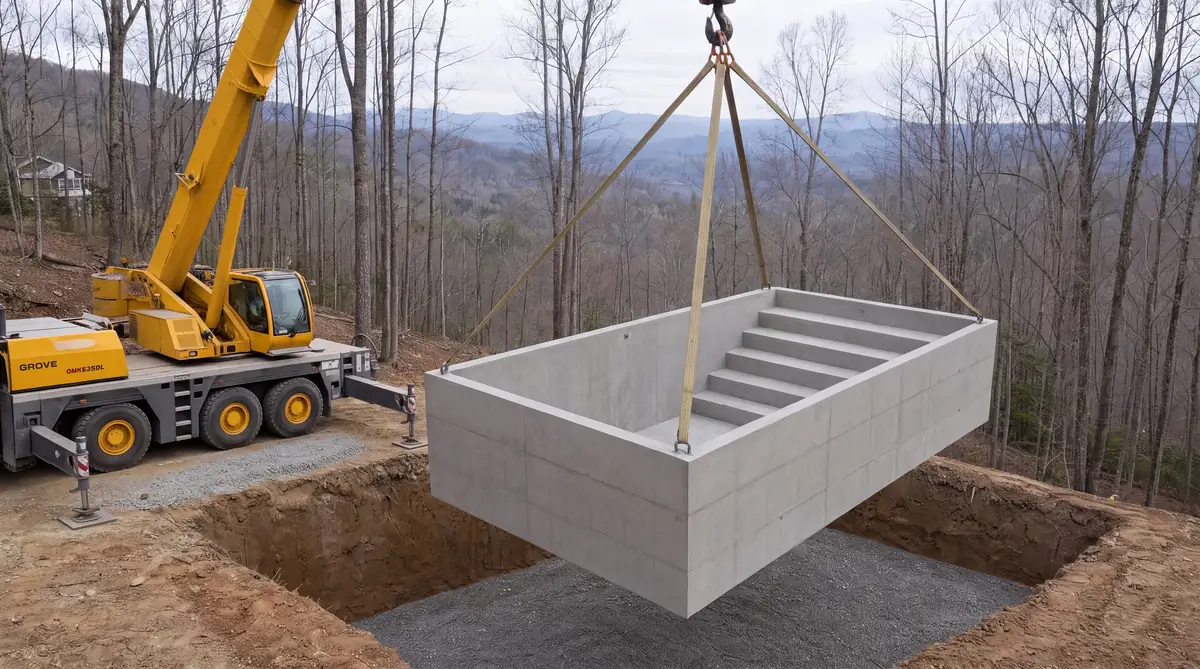
A precast pool is a reinforced concrete shell that is cast and cured in a factory, delivered whole and craned into place on your property. It is the same material as a traditional concrete pool, built in a completely different sequence, and the pool itself is finished before it ever reaches your lot.

Sizes run from small plunge shells of around 7 feet by 7 up to roughly 12 feet by 26, and narrow shells of around 7 feet reach properties that a full size pool cannot. Tile finishes, spa jets, waterfalls, swim jets, lighting and heating are all specified before the shell is made.

Precast is the type most people in this region have never heard of and the one that most often turns out to suit their property, which is why we will always show it to you alongside the others.

Read more about precast concrete pools. From $65,000 to $150,000 installed.

Fiberglass pools

A fiberglass pool is a one piece shell made in a mold, with the steps, the bench seats, the tanning ledge and the depth profile all built into it. The interior surface is gelcoat, which is smooth underfoot and holds less algae than a concrete finish, so it takes less sanitizer and less brushing to keep clear.

Fiberglass offers a very large range of shapes and sizes to choose from. Widths run from around 8 feet up to 16, lengths reach roughly 40 feet, and depths run from a little under 5 feet on a flat bottom model to around 8 feet on the deepest ones. Rectangles, freeform shapes, lap pools, pools with a tanning ledge across one end and pools with a spa seat built into a corner are all available without anything having to be made specially.

The 16 foot ceiling on width comes from the road rather than from the pool, because most states cap an oversized load at 16 feet wide and the shell has to travel to you on a truck. Every shape comes from an existing mold, so whatever is built into the shell is decided when you order it and cannot be changed afterward.

Read more about fiberglass pools. From $60,000 to $150,000 installed.

Gunite pools

A gunite pool is built where it sits. A cage of steel reinforcing bar is tied inside the hole, concrete is sprayed onto that cage under pressure through a hose, and the surface is shaped by hand as it goes on. Once it has cured it is tiled, finished inside with plaster, quartz, pebble or tile, and filled.

Because nothing is delivered, a gunite pool can be any shape, any depth and any size you can obtain a permit for, and it can be built on a property that no truck or crane can reach. The concrete then has to cure in your yard for about a month, and the tile, the interior finish and the filling all follow that, which is why a gunite project is measured in months.

Read more about gunite pools. From $90,000 installed.

Fiberglass, gunite, or precast concrete?

Most people who call us have heard of fiberglass and gunite pools and are trying to decide between them. In our experience the decision is usually made by the property rather than by the preference, and there is a third option in between the two which very few people in this region know about.

Fiberglass gives you a finished shell, a smooth interior and a short build. The choice of shapes is very large, widths run from around 8 feet up to 16, and depths reach around 8 feet.

Gunite gives you any shape and any depth, at the highest cost of the three and with several months of construction in your yard.

Precast concrete gives you the material of a gunite pool with the delivery of a fiberglass one. The shell is concrete, cast and cured under factory conditions rather than in your yard, and it arrives finished. It is also the narrowest of the three, starting at around 7 feet, which reaches properties a full size shell cannot.

We will lay all three out against your own property, with what each one would cost, and work through with you which of them are realistic.

How much does an inground pool cost in Asheville?

Pool typeInstalled range
Fiberglass pool$60,000 to $150,000
Precast concrete pool$65,000 to $150,000
Gunite pool$90,000 to $200,000 and up
Decking and surroundPriced per square foot

The lowest figure in every range assumes a level site: flat ground, easy access for the crane, and a modest surround, all of which is the exception around here rather than the rule. How much grading and excavating your ground needs is the single biggest thing moving your number, along with the size of the pool and everything you put around it, including decking, patio, a shaded area, tile, rockwork and water features.

What moves you inside the range

The ground work. How much ground has to be cut, how much has to be held back by a wall, and how much soil leaves your property. On a level lot the dig is simply a hole. On a slope it involves a cut into the hillside, retaining walls, and a considerable amount of material leaving your property. Ground work is the largest single variable in a quote in this region, and it is the reason two lots four miles apart can be very different numbers for the same pool.

Rock. Whether there is any, how deep it begins, and how it has to be broken out.

Access. Whether a delivery truck and a crane can reach your backyard, or whether the pool has to be a different pool entirely.

The size and type of pool. The obvious factor, and frequently not the largest one.

The surround. Square footage times material. Concrete, pavers, stone and tile cover a wide range, and on most projects the patio costs more than people expect.

Drainage and retaining walls. On sloped ground this is often the entire difference between two quotes that otherwise look identical, and it is the part that becomes invisible once it is finished.

Heating, a cover, lighting, automation and salt chlorination. Each one is a real line on the quote, and each one is materially cheaper installed with the pool than added later.

What drives the cost of a pool in this region

What should be in your quote

Your quote should tell you what is going to happen to your ground, not only what the pool costs. A good quote covers what gets dug, what gets held back, what leaves the property and what the pool will sit on. It should also cover where water goes in a storm, how the electrical work is run and grounded, what the surround is made of and how large it is, and what happens if rock turns up.

If a quote you are comparing does not cover those things, you are not comparing two prices for the same job. We will walk you through ours line by line so that you can see exactly what you are buying.

Precast concrete pool shell being set by crane
One company, one quote

The grading, the pool, the decking, the lighting and the planting run as one project on one schedule, rather than five separate trades for you to coordinate.

We handle the permitting from application through final inspection, so you do not file anything and you do not chase an inspector.

See all services

Building a pool in the mountains

Your slope decides the design

Two properties 4 miles apart can be entirely different pool projects, even where the mailing address looks much the same. How much your land slopes where the pool would go changes the dig, the retaining walls, the drainage and the access, and it changes all of them before anybody talks about shapes.

Ground conditions change from street to street

Rock depth, soil, springs and the way the ground drains are not consistent across a neighborhood, let alone across a county. A figure quoted over the phone is therefore a guess, and a figure quoted after a site visit is not.

Access decides which pools are possible

More pools in this region are ruled out by the route to the yard than by the yard itself, which is why we check it at the start rather than at the end.

Water has to be planned for, not dealt with afterward

Roof water, hillside runoff and where heavy rain goes have to be designed for on sloped ground. Handled properly, the drainage is something nobody ever notices. Handled badly, the patio moves, the retaining walls work harder than they were built to, and the pool area is unusable after a storm.

Heating decides how long your season lasts

At this elevation the limit is water temperature rather than air temperature. Clear mountain nights draw heat out of a pool overnight, so an unheated pool gives back much of what the day put into it and warms up weeks later in spring. A heat pump and a cover do not buy you a better July, but they do buy you a usable May and a usable October.

How we build your pool, step by step

Step one: the phone call

You tell us what you are picturing and where your lot is, and we talk through whether there is anything about your property we should know before anybody drives out.

Step two: the site visit

The site visit is where we measure everything that decides the price. We check how much your land slopes, how deep the rock is, where water runs in a heavy rain, how wide and how steep the driveway is, and how far it is to your electrical panel. We also locate the septic tank, the drain field and the reserve area. This visit turns a price range into a figure you can rely on.

Step three: design and pool recommendation

We go through which of the three types your property will take, what size fits where it can go, and what your ground has to do to accept it. If two of the three work, we will walk you through both and explain the trade between them. If only one works, we will say so rather than selling you the other two.

Step four: your written quote

We write the quote against what we measured, with the ground work itemized rather than buried in a single line, and we go through it with you line by line.

Step five: permitting, build and handover

We submit the application to the county and we schedule and meet the inspections. Permitting is handled from application through final inspection, so you do not file anything and you do not chase an inspector. Then the build, the filling, the water balancing, the equipment startup, and showing you how to run it.

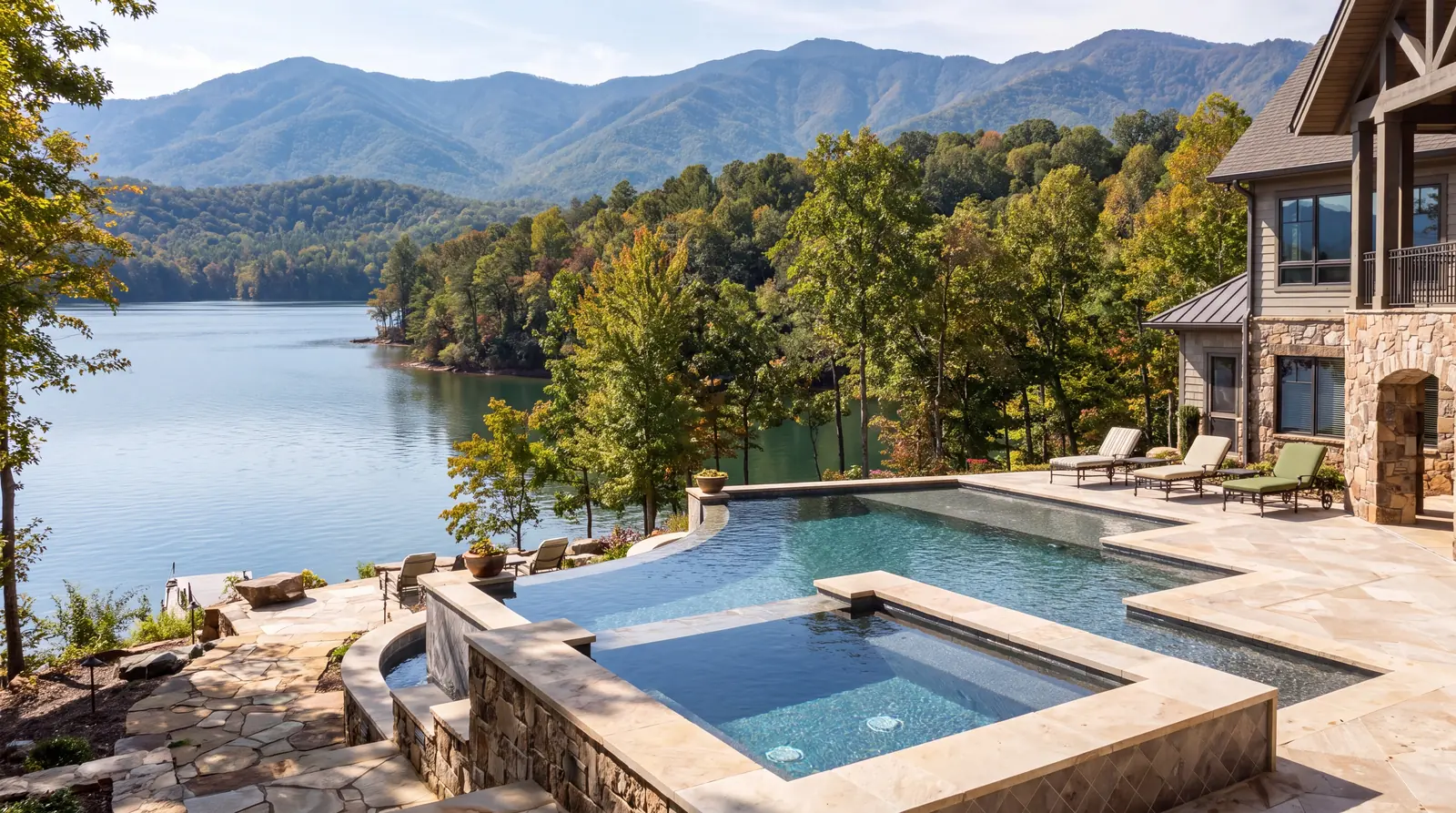
Infinity edge pool and spa overlooking a lake
Built for mountain property

Three things decide a pool project in this region: the slope of your land, the ground underneath it, and how easily we can reach the backyard. Our recommendation follows your property rather than a catalog, which on mountain ground matters a great deal more than it does anywhere flat.

Talk to us about your backyard

One company, one quote

A pool touches grading, drainage, retaining walls, concrete, plumbing, electrical work and hardscape. Every one of those stages has to be sequenced and inspected in the right order, and when they are contracted separately the gaps between them become yours to manage.

Run as one project, the grading, the pool, the patio and decking, the drainage, the lighting and the planting share one schedule and one point of responsibility. Single responsibility matters most on exactly the properties where it is hardest, meaning the steep ones, the tight ones, and the ones where the ground turns out to be something other than what everybody assumed.

Talk to us about your backyard

Tell us where you are and what you are picturing. We will come out, measure what you have, and work through with you which pools suit your property and what each one would cost.

Inground Pool Installation in Asheville, NC FAQs

What types of inground pool do you install?

Four. Precast concrete pools, which are cast and cured in a factory and craned into place finished. Fiberglass pools, which are one piece shells made in a mold and also delivered finished, in a very large range of shapes and sizes. Gunite pools, which are concrete sprayed and shaped in your yard and can be built in any shape or depth you want. And shipping container pools, which arrive largely complete with the filtration and plumbing already fitted.

Which type of pool should I choose?

It usually comes down to three questions. How much work your ground needs before a pool can go in, whether a delivery truck and a crane can reach your backyard, and whether the pool you have in mind is a shape somebody already makes. We answer all three at the site visit, and then we go through the realistic options with you rather than steering you toward one.

How much does an inground pool cost around Asheville?

Fiberglass pools generally run from $60,000 to $150,000 installed, precast concrete pools from $65,000 to $150,000, and gunite pools from $90,000 upward. Most projects land well inside those ranges rather than at the bottom of them, because the lowest figure assumes a level site with easy access, which around here is the exception rather than the rule.

Why does a pool cost more here than it does somewhere flat?

Because of the work that happens before the pool arrives. On a level lot the dig is simply a hole. On a mountain lot it involves cutting into the slope, building walls to hold back the ground above the pool, hauling away what comes out, and building drainage so that heavy rain runs somewhere other than across your pool area. That work is the largest single variable in a quote in this region, and it is why we will not put a real number on a project until we have stood in the yard.

How long does an inground pool take to build?

Most of our precast concrete and fiberglass projects are completed in 4 to 12 weeks, because the shell arrives already built and the work on your property is ground work. A gunite pool takes months, because the concrete is sprayed in your yard and then has to cure there for about a month before the tile, the interior finish and the filling can begin. On any of them, how much ground has to be moved decides more of the schedule than the pool itself does.

Do I need a permit for a pool?

Yes, in both counties, and the barrier around the pool and the electrical work form part of it. We handle the permitting from application through final inspection, so you do not file anything and you do not chase an inspector.

What happens if you hit rock during the dig?

Rock is normal in this region, and it is a cost rather than a reason to stop. What matters is whether it was priced before the dig began or discovered halfway through it. We would encourage you to ask that question of every quote you are comparing, because the answers vary considerably more than the prices do.

Can I put an inground pool in if I am on a septic system?

In most cases yes, although the septic system decides where the pool can sit rather than you. Nothing can be built over the tank or the drain field, including the patio and the equipment, and the field also has a reserve area that has to stay clear. Locating all of it is one of the first things we do on a site visit, and it is a common reason that a smaller pool turns out to be the better answer.

How long is the swimming season at this elevation?

Longer than most people expect, provided the pool is heated. The limit here is water temperature rather than air temperature, because clear mountain nights draw heat out of a pool overnight. Without heating, a pool warms up late in spring and cools off early in fall. A heat pump and a cover are what give you a usable May and a usable October.

My driveway is narrow and steep. Does that rule out a pool?

No, although it does narrow the choice. A full size fiberglass shell can be up to 16 feet wide and travels on an oversized trailer, so a tight driveway will often rule that out. Both types come in much narrower sizes, though: precast concrete pools from around 7 feet and fiberglass pools from around 8, so a finished shell can usually still reach the backyard. A gunite pool is built in your yard, so there is nothing to deliver at all. We check your access before we design anything.

Do you build the patio and decking as well?

Yes, and we would encourage you to have it done at the same time. The grading, the pool, the patio and decking, the drainage, the lighting and the planting run as one project on one schedule, which is both cheaper and the only way the levels and the drainage come out right.

Can you build a pool for a vacation rental property?

It is a common reason people call us, and a pool is one of the strongest things a rental property can offer in this area. A rental pool gets used harder than a family pool, so we would recommend confirming what your county and your insurer require before the design is settled rather than afterward, and we can talk that through with you.

Get a Quote for Your Pool

Tell us where you are and what you are picturing. We will come out, measure what you have, and work through with you which pools suit your property and what each one would cost.

Call Now Free Quote