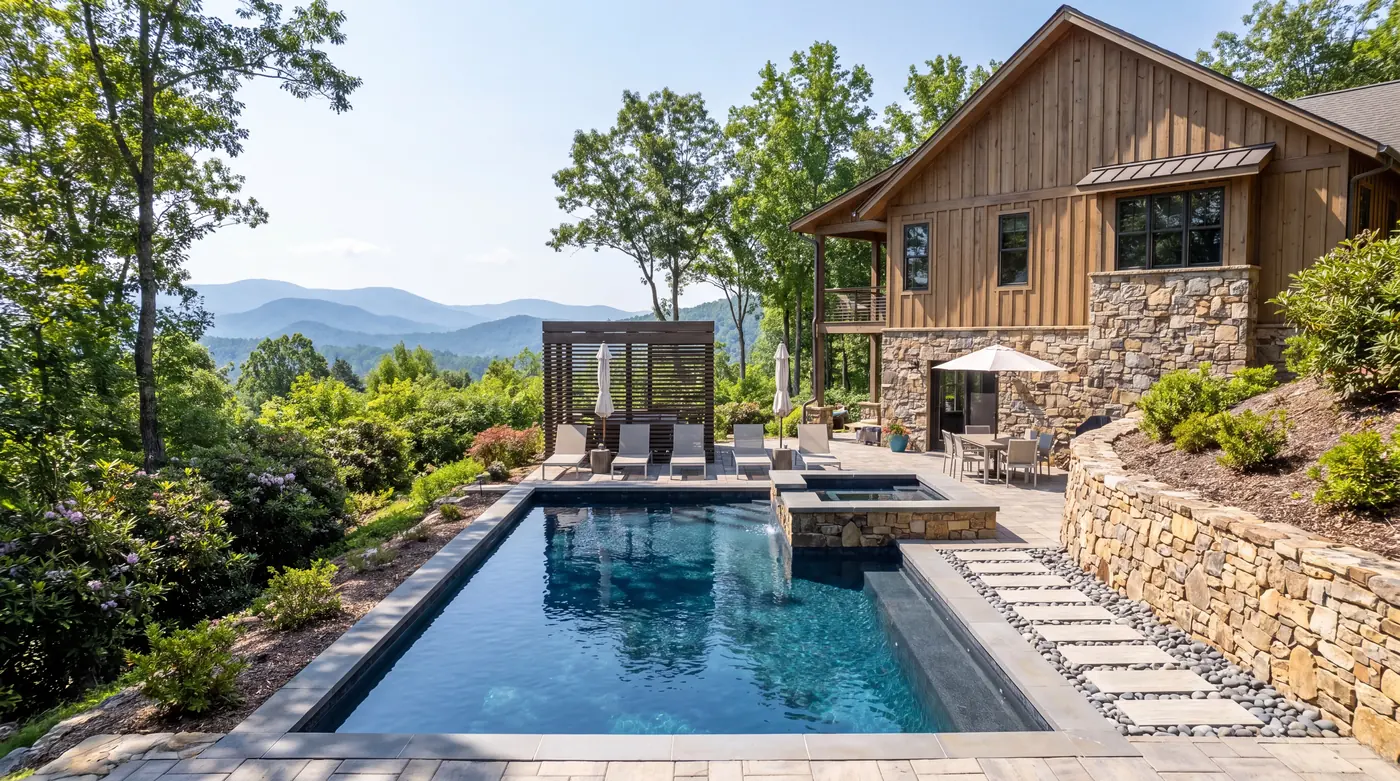
Most of our precast projects are completed in 4 to 12 weeks. A conventional concrete pool is built in your yard over months, whereas a precast pool arrives complete, so the only work on your property is ground work: the dig, the base, the drainage, any retaining walls and the surround. On mountain land the ground work is the part worth controlling anyway, and it is the part we take off your hands.
Why precast suits what most people want
Most people who call us about a precast pool want three things at once. They want a pool that looks like it belongs in their yard, they want the whole backyard finished rather than a pool sitting in a building site, and they want to be swimming this year.
Precast delivers all three, which is why most of our conversations end up here. The shell is concrete, so it can be finished in real tile and it sits in a landscape the way a built pool does. The pool arrives already made, so your yard is open for weeks instead of a whole summer. And because the pool is a known quantity before it reaches you, we can spend the design time on the part that varies, which is your land and everything you want around the water.
A stronger pool than concrete poured in your yard
A precast shell is cast in a factory, not in your backyard. The difference shows up in the concrete. Indoors the mix is measured rather than judged by eye, and it can carry additives a truckload delivered to a job site cannot. The shell is filled evenly the whole way around, so no part of it is left with air pockets or thin spots. What comes out is harder and much denser than concrete placed in a yard in whatever weather that week happens to bring.
Density matters as much as raw strength does at this elevation. Water that cannot soak into the concrete cannot freeze inside it and force it apart, and a pool up here goes through a freeze and thaw cycle every winter of its life.
What a precast pool installation involves
The site visit
Before anything is priced, we come out and measure your yard. We check how much your land slopes where the pool would go, how deep the rock is, where water runs in a heavy rain, how wide and how steep your driveway is, and how far it is to your electrical panel. We also work out whether there is anywhere a crane can park and still reach the backyard. Those few measurements decide the design and most of the price.
Design
The design stage is where the pool, the levels and its position in the yard are really decided, and we do that part together with you. We work out where the water should sit in relation to the house, what you look out at from it, where the afternoon sun falls, and where the seating and the fire feature want to be. We also plan how the whole space is lit once the sun drops behind the ridge. The pool follows that conversation rather than starting it.
Specifying the shell happens here as well, and with precast it happens early. Spa jets, swim jets, tile, steps, benches, lighting, heating and the water feed are all built into the shell when it is cast. None of them can be added afterward, so we go through the whole list with you before anything is ordered.
Permits
The application goes to the county with the pool engineering drawings and the footing details, which come from the factory and are matched to the kind of ground you have. We handle the permitting from application through final inspection, so you do not file anything and you do not chase an inspector.
The dig and what the pool sits on
The hole is dug wider than the pool so there is room to work around it and room to fill it back in properly afterward. A precast shell is one solid piece of concrete and it never sits straight on dirt, because anything soft underneath it will let the pool settle and you will see the result.
We set ours on a poured concrete base rather than the compacted gravel a lot of installers use. A solid slab spreads the weight evenly and there is nothing underneath it that can shift or wash out. On a lot cut into a slope, where part of the ground is original and part is fill that has just been placed, that matters, because the two do not settle the same way.
The slab costs more and we think it is worth it. Whichever company you go with, it is a fair question to ask all of them: what is the pool actually sitting on?
Delivery day
The pool arrives on a truck and a crane lifts it straight off and sets it into the hole, using lifting points built into the shell for exactly that purpose. Delivery is the day everything else is planned around, which is why we measure your driveway on the first visit. On a mountain lot with a switchback drive and mature trees overhead, finding somewhere the crane can park and still reach the backyard is often the hardest part of the whole project.
Backfilling and drainage
Gravel goes in around the outside of the shell a layer at a time, so that rainwater drains away from the pool rather than sitting against it. On sloping ground the drainage around the shell matters far more than it does on a flat lot. The electrical work is done by a licensed electrician and inspected before anything is covered over.
Plumbing and equipment
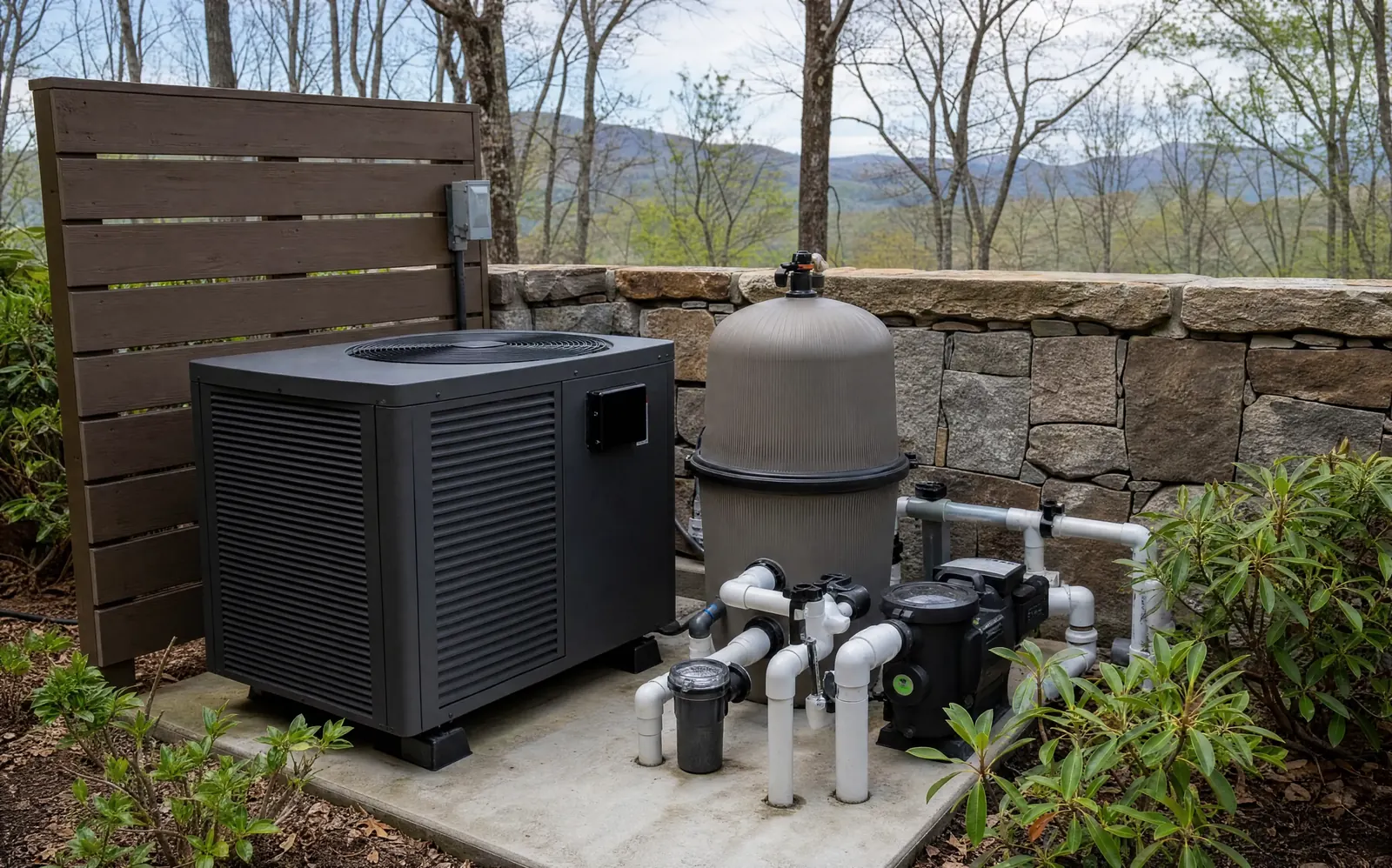
The skimmer and the water inlets are already built into the shell, so the plumbing is a matter of connecting them and running the lines back to the equipment. The equipment pad carries the pump, the filter, whatever you are using to keep the water clean, and a heater if you want to be swimming in May and September, and that work is inspected too.
Coping, patio and drainage
The coping caps the rim of the pool, and then everything around it goes in: the patio, the walkway and the steps. A large share of the budget goes into the surround, along with almost all of how the finished space looks, because poured concrete, stone and tile are three very different prices and three very different results.
Drainage is built at the same time, because on sloping ground the question was never whether rain reaches the pool area. The question is where the water goes once it arrives.
Filling and handover
Once the pool passes its final inspection we fill it, which takes a few hours on a garden hose or minutes if a water truck brings it. We then balance the water, start up the equipment and show you how all of it runs.