
📞 (828) 539-4201
Licensed & Insured Since 2019
Permits Handled End to End

Gunite Pools in Asheville, NC

Pool Builders of Asheville installs gunite pools across Buncombe, Henderson and Madison counties. A gunite pool is built where it sits, with a steel cage tied inside the hole and concrete sprayed onto it under pressure, then shaped by hand. Nothing about the pool is limited by what fits on a truck, so the design can be any shape, any depth and any size your property and your permit will carry.

Gunite is the pool we build when the design comes first and nothing is allowed to compromise it. Because the concrete is sprayed and shaped in your yard, nothing about the pool is decided by what fits on a truck, which covers the shape, the depth, the size and whether a crane could ever have reached your backyard. What you pay for that freedom is time on your property.

What gunite lets you build

Any shape you can draw

The outline of a gunite pool is drawn rather than picked from a range. A freeform pool can follow the line of your hillside, or work around a mature oak or a rock outcrop. A lap lane can sit at an angle that no mold comes in. All of those are normal requests here rather than special ones.

Any depth you want, and more than a single depth in the same pool

A shallow ledge at one end and real swimming depth at the other, in the same pool, is straightforward in gunite and impossible in a molded shell. So is a beach entry that walks in from the patio with no step at all, which people tend to remember longer than anything else about a pool.

A spa built into the pool

A spa that forms part of the pool structure and spills into the water is one build and one set of equipment rather than two. Of everything gunite can do, a built in spa is the most common reason people choose it once they have seen both options side by side.

A vanishing edge over a view

An edge where the water runs over and disappears only works where the ground falls away behind it, which is exactly what a great deal of property in this region does. A vanishing edge needs a catch basin below and its own pump, so it is a real cost rather than a detail, but on the right property it is the design that uses your land instead of fighting it.

Rock and water features

Boulder waterfalls, grottos, spillways and swim jets are built into the structure rather than bolted onto it afterward. Anything structural is designed in before the spray day.

Size

No ceiling applies other than the one your yard, your budget and your permit put on it.

What a gunite pool build involves

The site visit

Before anything is priced, we come out and measure your yard. We check how much your land slopes where the pool would go, how deep the rock is, where water runs in a heavy rain, how wide and how steep your driveway is, and how far it is to your electrical panel. We also work out where a mixer and a pump truck can stand on the day the concrete goes on. Those measurements decide the design and most of the price.

Design

Design is the step that gunite has and the delivered pools do not, and it is the part we do together with you. The outline, the depth profile, the steps, the ledges, the spa, the edge detail and the interior finish are all drawn rather than chosen from a range. Designing properly takes longer at the front of the project, and it is the whole reason you would pick gunite in the first place.

Permits

The application goes to the county along with the pool engineering drawings. We handle the permitting from application through final inspection, so you do not file anything and you do not chase an inspector.

The dig

The hole is cut to the drawn shape rather than to a rectangle, and that includes the deep end, the steps and the ledges. On a sloped lot the dig is also where the ground gets reshaped and where whatever needs holding back gets held.

Steel

A cage of reinforcing bar is tied inside the hole, across the floor and up the walls, and held off the ground so that the concrete gets underneath it rather than sitting on top of it. The steel cage is the structure of the pool, and the concrete that follows is what encases it.

Plumbing before concrete

Return lines, skimmers, main drains, the lines for any water features and the conduit for the lights all go in before the concrete does, because after the spray day every one of them is permanently inside the wall. Anything you want plumbed into this pool is decided now.

Spray day

Concrete is fired through a hose at high pressure onto the steel and worked by hand as it lands, across the floor, the walls, the steps and the ledges. Spray day is one continuous operation and it is the day the pool stops being a hole and becomes a shape. The finished surface is cut and shaped by hand, which is why the skill on the nozzle and the trowel shows up in the result.

Curing

The concrete has to cure in your yard. The shell is kept wet through the first stretch, and it takes about a month to harden. Nothing about that can be hurried, because it is chemistry rather than scheduling, and it is the single biggest reason a gunite build is measured in months.

Tile, coping and the patio

As the concrete cures, the work moves outward to the waterline tile, the coping around the top of the pool, and the patio and decking. Drainage is built here as well, which covers where roof water and hillside runoff go, and where they go instead of across the pool area.

Interior finish

Once the concrete has cured, the inside gets its finish in plaster, a quartz or pebble aggregate, or tile. The interior finish is the surface you actually touch and the one that eventually wears out, so the trade between the options is worth understanding before you pick.

Filling, startup and handover

We fill the pool, balance the water, and start up and set the equipment. A new plaster or aggregate finish needs particular care in its first weeks, with brushing and water chemistry watched more closely than it will ever be watched again, and we show you exactly what that involves.
Not sure which pool suits your property?

Tell us where you are and what you are picturing, and we will work through the options with you.

Request a Quote

Why gunite works on Western North Carolina properties

Two features of mountain ground point at gunite specifically: lots too steep or too tight for a crane, and shapes no factory makes.

Access. Nothing about a gunite pool is delivered whole. A narrow driveway, tight switchbacks, mature trees or overhead power lines describe an ordinary property up here, and on one of those a 16 foot shell on a trailer is simply not arriving. A gunite pool is built from material that comes in on a normal truck and goes through a hose, so the pool that cannot be delivered can still be built.

Ground that already has a shape. A lot that drops away is a problem for a rectangular shell and an opportunity for a drawn pool. Cutting a pool into a slope, stepping it, raising one side or running a vanishing edge along the low side are designs that only make sense on ground like this, and they only exist in concrete.

Septic is the constraint nobody mentions until it is a problem

A great deal of this market is on septic, and the septic system decides where a pool can physically go.

Nothing can be built over the tank or the drain field, and that includes the pool, the patio and the equipment pad. The field also has a reserve area that has to stay clear so that it can be replaced one day, and that reserve is easy to build over by accident, because there is nothing to see on the surface.

Locating the tank, the field, the reserve and the buried lines is one of the first things we do on a site visit. With gunite the septic layout usually changes the shape of the pool rather than ruling it out, which is an advantage a molded shell does not have.

A shorter season, and what to do about it

Clear mountain nights draw heat out of a pool overnight, so an unheated pool warms up late in spring and cools off early in fall. A heat pump and a cover are what buy you a usable May and a usable October, and both are considerably cheaper installed with the pool than added afterward.

Gunite compared with the pools that arrive finished

Gunite and precast concrete

Both pools are concrete, and the difference is where they are made. A precast pool is cast and cured in a factory and craned in finished, at a concrete strength a site mix does not reach, and most precast projects are completed in 4 to 12 weeks. A gunite pool is sprayed and cured in your yard, comes in any shape and any depth, and takes months. If a precast size genuinely works for your property, precast will be the quicker and far less disruptive project.

Gunite and fiberglass

A fiberglass pool is a one piece composite shell from a mold, capped at around 16 feet wide by the road rather than by the pool. Fiberglass is smooth underfoot and quick to install, in catalog shapes only. Gunite has more texture underfoot, takes months, and has no limit on shape at all. The two sit at opposite ends of the same trade.

How much does a gunite pool cost in Asheville?

Most gunite pools around here land between $90,000 and $200,000 installed, and genuinely custom work runs past the top of that.

The lowest figure in that range assumes a level site, which means flat ground, easy access and a modest surround, and around here that is the exception rather than the rule. How much grading and excavating your ground needs is the single biggest thing moving your number, along with the size of the pool and everything you put around it, including decking, patio, a shaded area, tile, rockwork and water features.

What moves you inside the range

Square footage and depth. More surface and more depth means more of everything: more dig, more steel, more concrete, more finish, more water and more heating.

Shape. A freeform outline with ledges, a beach entry and a spa is more work at every single stage than a rectangle is.

Interior finish. Plaster, quartz, pebble and full tile cover a wide spread in price, and they do not last the same length of time as each other either.

Ground work. Cutting into a slope, holding back what sits above the pool, and hauling away what comes out of the hole.

Rock. Whether there is any, how deep it begins, and how it has to be broken out.

Weeks on site. Gunite is priced partly in time, and time on a mountain lot is not the same as time on a flat one.

Water features, a vanishing edge or a spa. Each one has its own structure, its own plumbing and often its own pump.

The surround. Square footage and material, where concrete, pavers, stone and tile are four very different numbers.

What drives the cost of a pool in this region

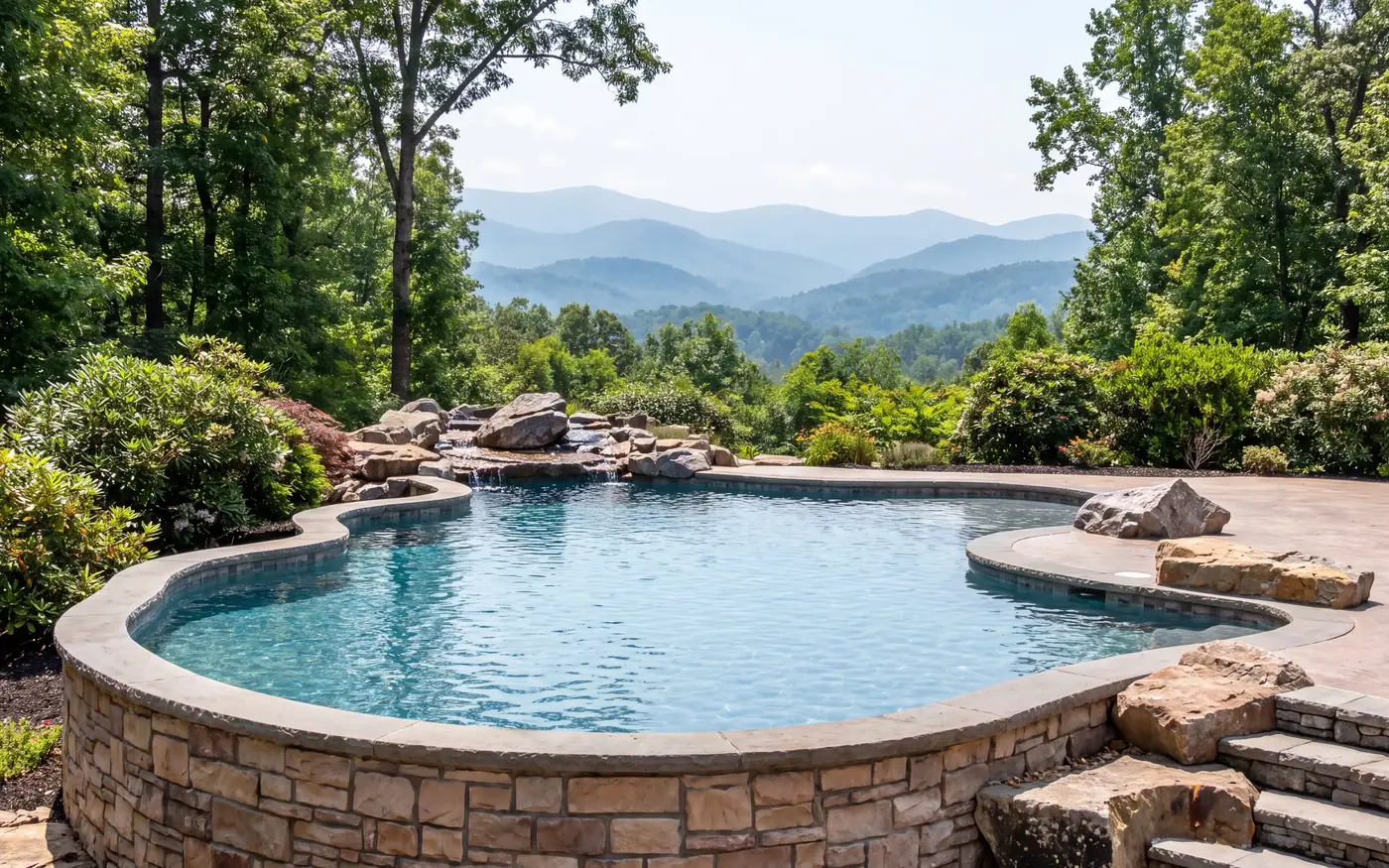
Freeform pool with a boulder waterfall and a mountain view
One company, one quote

The grading, the pool, the decking, the lighting and the planting run as one project on one schedule, rather than five separate trades for you to coordinate.

We handle the permitting from application through final inspection, so you do not file anything and you do not chase an inspector.

See all services

How long does a gunite pool take?

Expect months rather than weeks, and three to six is a fair range once the permitting, the dig, the steel, the plumbing, the spray day, the cure, the tile, the finish, the patio and the startup are all counted.

The 28 day cure is the fixed part of that schedule. Everything else can be sequenced and overlapped, and patio work happens while the concrete cures, but the concrete gets its month regardless of what anybody wants.

Weather counts for more here than it would somewhere flat, because ground work during a wet spell does not slow down, it stops, and the spray day needs conditions of its own.

Is a gunite pool right for your property?

A gunite pool suits you if

  • The pool you want is not a shape anybody makes a mold for
  • You want a spa built into the pool, a beach entry, a vanishing edge or a real deep end
  • Your lot has slope on it and you would rather use that than fight it
  • Nothing wide can reach your backyard at all
  • You would rather have exactly the right pool in October than a good enough one in June

A gunite pool is the wrong choice if

  • You want to swim this season. A precast or fiberglass pool is completed in 4 to 12 weeks, whereas this is measured in months.
  • A standard rectangle is what you actually want. You would be paying for freedom you are not using.
  • Months of ground work and trades in your yard is not acceptable. Your property is a construction site for a long stretch, and that is worth being honest with yourself about.
  • Your yard is small. The cost of building in place does not shrink in proportion with the pool, so a compact precast shell usually makes more sense.

Talk to us about a gunite pool

Tell us where you are and what you are picturing. We will come out, measure what you have, and work through with you which pools suit your property and what each one would cost. If the design you want only works in gunite, we will say so and talk you through what that means for the budget and the schedule.

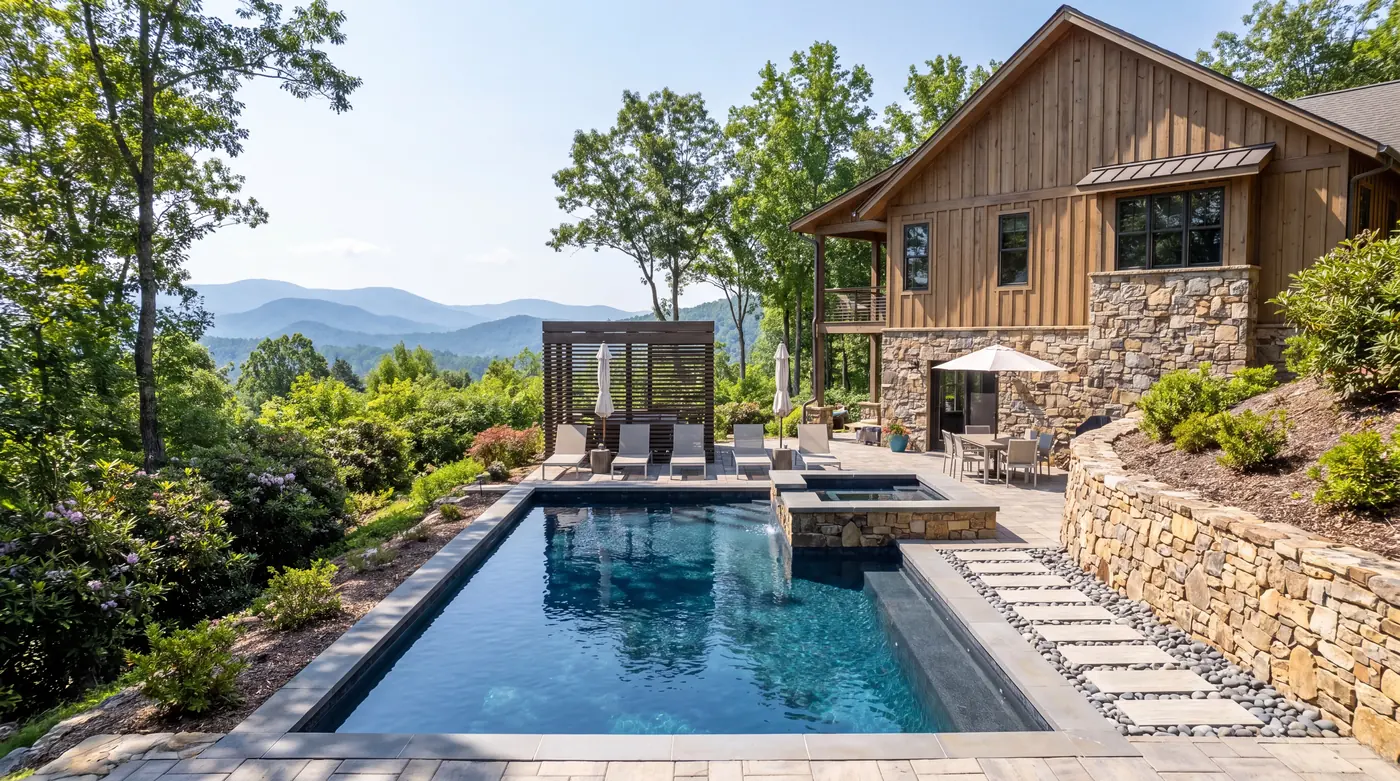
Rectangular pool with a spillover spa
Built for mountain property

Three things decide a pool project in this region: the slope of your land, the ground underneath it, and how easily we can reach the backyard. Our recommendation follows your property rather than a catalog, which on mountain ground matters a great deal more than it does anywhere flat.

Talk to us about your backyard

Gunite Pools in Asheville, NC FAQs

What is a gunite pool?

A gunite pool is a concrete pool built in place. A steel reinforcing cage is tied inside the hole, then concrete is sprayed onto that cage at high pressure through a hose and shaped by hand as it goes on. Once it has cured, the pool is tiled, finished on the inside and filled. Nothing is delivered whole, which is the reason a gunite pool can be any shape at all.

Why would I choose gunite over a pool that arrives finished?

Two reasons, and they are the only two that matter. The first is design freedom, because a gunite pool can be any outline and any depth, with a beach entry, a vanishing edge, a spa built into the structure or a swim lane, none of it limited by a mold. The second is access, because nothing gets delivered, so a property that no truck or crane can reach is still buildable. If neither of those applies to you, a precast concrete or fiberglass pool will be faster and far less disruptive.

How long does a gunite pool take to build?

Months rather than weeks, and three to six months is a fair expectation from start to swimming. The concrete alone takes about a month to harden in your yard, and the tile, the interior finish, the filling and the startup all come after that. Around the concrete you also have the permitting, the dig, the steel, the plumbing, the spray day, the patio and the equipment, and mountain weather is a real part of the schedule.

How much does a gunite pool cost around Asheville?

Most gunite projects land between $90,000 and $200,000 installed, and genuinely custom work runs past the top of that. Gunite is the most expensive of the pools we install because it is built rather than delivered, which means more weeks on your property, more trades and more material. Depth, shape, square footage and the interior finish are what move the number most.

Can a gunite pool go on a steep lot?

Yes, and a steep lot is often where gunite earns its money. Nothing has to be delivered whole, so the access problem that rules out a large shell does not apply. The pool can be cut into the slope with the uphill side held back, or built raised with the low side carried on structure, and a vanishing edge on a property that already drops away is a design that only really works on ground like this.

What is the inside of a gunite pool finished with?

Plaster, a quartz or pebble aggregate, or tile. Plaster is the traditional and least expensive option, and it is also the one that wears fastest. Quartz and pebble finishes are harder and last longer. A fully tiled interior is the most expensive and the longest lived of the three. Whichever you choose goes on after the concrete has cured rather than before.

Do gunite pools need resurfacing?

Yes, eventually, because an interior finish is a wearing surface. Plaster is generally reckoned to need redoing somewhere around the ten to fifteen year mark, and harder finishes last longer than that. Resurfacing is a real ownership cost and it is worth knowing about before you choose rather than afterward.

Is a gunite pool rougher underfoot than a fiberglass one?

It has more texture, yes. Plaster and pebble are concrete finishes and they feel like it, particularly a pebble finish. Some people prefer the grip on the steps and a shallow ledge, and some people find it hard on their feet, so it is worth putting a hand on samples of each before you decide.

I am on a septic system. Can I still put in a gunite pool?

In most cases yes, although the septic system decides where the pool can sit rather than you. Nothing can be built over the tank or the drain field, including the patio and the equipment, and the field also has a reserve area that has to stay clear. Locating all of it is one of the first things we do, and with gunite it usually changes the shape of the pool rather than ruling it out.

Can you build a spa into the pool?

Yes, and it is one of the strongest arguments for gunite. A spa built into the pool structure, spilling into the water, is one pour and one set of equipment rather than a separate tub sitting next to the pool. The spa has to be designed in from the start rather than added later.

What happens if you hit rock during the dig?

Rock is normal in this region and it is a cost rather than a reason to stop. What matters is whether it was priced before the dig began or discovered halfway through it. We would encourage you to ask every quote you are comparing how rock is handled and who carries it, because the answers vary considerably more than the prices do.

Do I need a permit for a pool in Buncombe County?

Yes. We handle it from application through final inspection, so you do not file anything and you do not chase an inspector.

Do you build the deck and surround too?

Yes, and it belongs in the same quote. The coping and the patio and decking, in concrete, pavers, stone or tile, go in alongside the drainage, the lighting and the planting around the pool.

Get a Quote for Your Pool

Tell us where you are and what you are picturing. We will come out, measure what you have, and work through with you which pools suit your property and what each one would cost.

Call Now Free Quote